Oggi avete aperto, ancora una volta, il vostro piccolo strumentino digitale che vi permette di osservare in silenzio, svariati social media, convinti di essere invisibili.
Non troverete nulla. Non troverete storie, non troverete account, non troverete la finestra sul mio mondo che cercate con tanta, inspiegabile dedizione.
Vi invito, con tutto il rispetto che riesco a raccogliere per chi spreca il proprio tempo in questo modo, a ridirigere le vostre energie verso qualcosa che vi appartenga davvero.
E vi invito, soprattutto, a farlo tempestivamente.
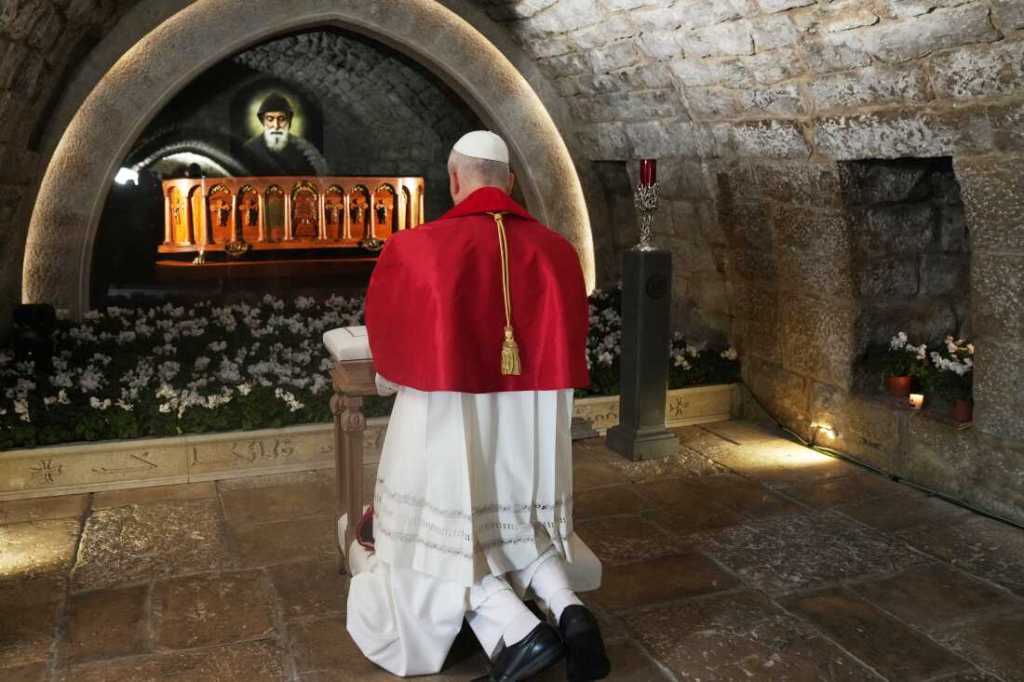
Papa Leone XIV prega davanti alla tomba di San Charbel Makhlouf presso il Monastero di San Maroun, ad Annaya, in Libano, lunedì 1° dicembre 2025. (Foto AP/Domenico Stinellis, Pool)– Fair use
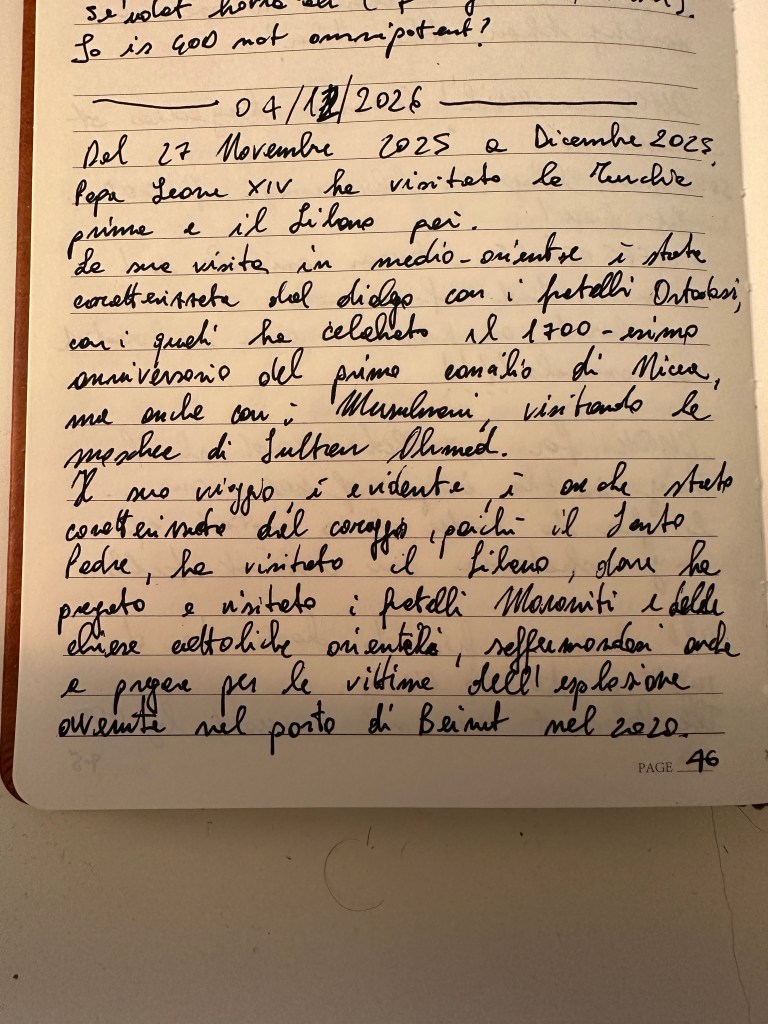
Tra novembre e dicembre 2025 Papa Leone XIV ha visitato la Turchia prima e il Libano poi.
La sua visita in Medio Oriente è stata caratterizzata dal dialogo con i fratelli ortodossi, con i quali ha celebrato il 1700esimo anniversario del primo concilio di Nicea, nonché con i musulmani, visitando la moschea di Sultan Ahmed.
Il suo viaggio, è evidente, è anche stato caratterizzato dal coraggio, poiché il Santo Padre, ha visitato il Libano, dove ha pregato e visitato i fratelli Maroniti e delle chiese cattoliche orientali, soffermandosi anche a pregare per le vittime dell’esplosione avvenuta nel porto di Beirut nel 2020.
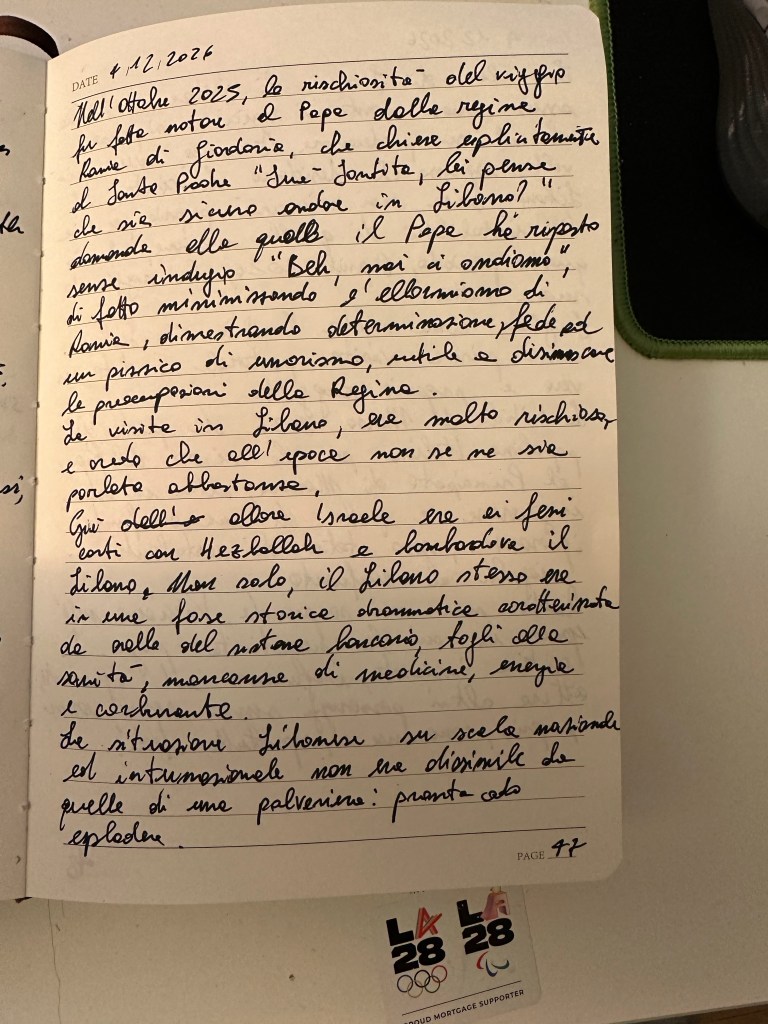
Nell’Ottobre 2025, la rischiosità del viaggio fu fatta notare al Papa dalla regina Rania di Giordania, che chiese esplicitamente al Santo Padre “Sua Santità, lei pensa che sia sicuro andare in Libano?” domanda alla quale il Papa ha risposto senza indugio “Beh, noi ci andiamo”, di fatto minimizzando l’allarmismo di Rania, dimostrando determinazione, fede ed un pizzico di umorismo, utile a disinnescare le preoccupazioni della Regina.
La visita in Libano era molto rischiosa, e credo che all’epoca non se ne sia parlato abbastanza.
Già allora Israele era ai ferri corti con Hezbollah e bombardava il Libano. Non solo: il Libano stesso era in una fase storica drammatica, caratterizzata dal crollo del settore bancario, tagli alla sanità, mancanza di medicine, energia e carburante.
La situazione libanese, su scala nazionale e internazionale, non era dissimile da quella di una polveriera: pronta a esplodere.
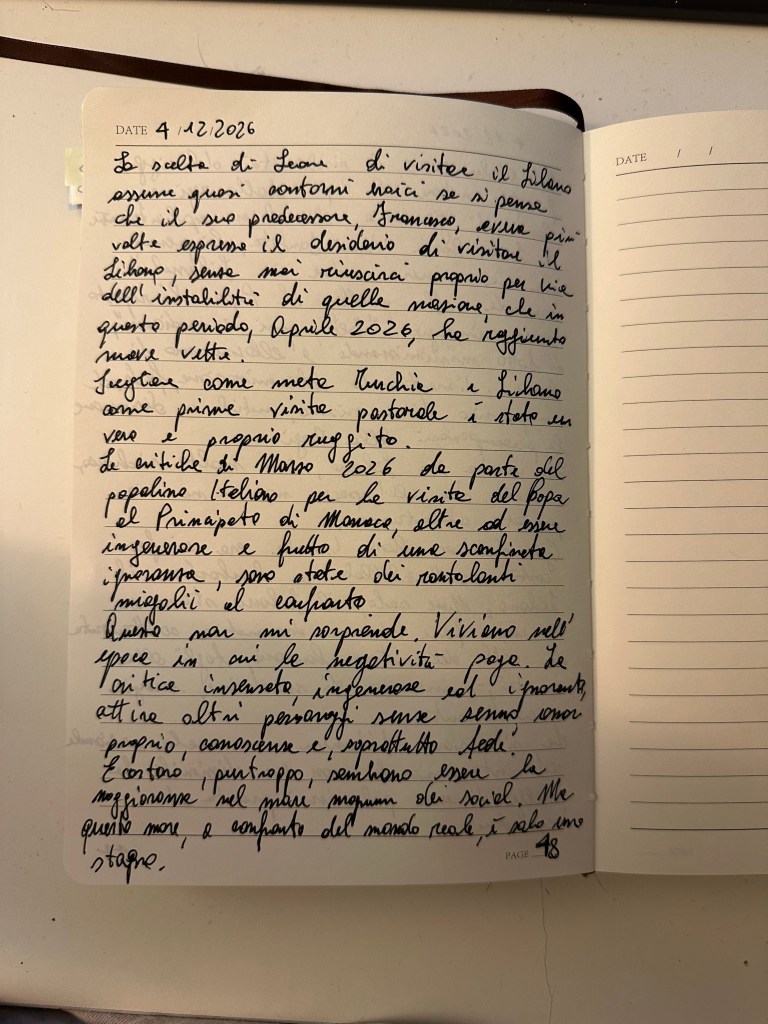
La scelta di Leone di visitare il Libano assume quasi contorni eroici se si pensa che il suo predecessore, Francesco, aveva più volte espresso il desiderio di visitare il Libano, senza mai riuscirci proprio per via dell’instabilità di quelle nazioni, che in questo periodo, aprile 2026, ha raggiunto nuove vette.
Scegliere la Turchia e il Libano come prime visite pastorali è stato un vero e proprio ruggito.
Le critiche di marzo 2026 da parte del popolino italiano per le visite del Papa al Principato di Monaco, oltre a essere ingenerose e frutto di una sconfinata ignoranza, sono state dei rantolanti miagolii al confronto.
Questo non mi sorprende. Viviamo nell’epoca in cui la negatività paga. La critica insensata, ingenerosa ed ignorante, attira altri personaggi senza senso, amor proprio, conoscenza e, soprattutto fede.
E costoro, purtroppo, sembrano essere la maggioranza nel mare magnum dei social. Ma questo mare, a confronto del mondo reale, è solo uno stagno.
I miei pensieri vengono generalmente battuti a mano su un editor di testo (e.g. Word o Writer) e poi rifiniti. In questo caso, invece, questo pensiero l’ho prima manoscritto di getto, e poi riportato in forma digitale. RIFIUTA ANCHE TU LA GENERAZIONE INDISCRIMINATA DI TESTO CON L’INTELLIGENZA ARTIFICIALE!
Exaggerations, social media fights, and constant alarmism make his tenure deeply problematic.
Guido Crosetto, Italy’s minister of defense, has a problem. It’s called X, formerly Twitter. Go look at his replies and you may find a flood of insults aimed at anonymous accounts: “moron,” “idiot,” “ignorant,” “loser,” “shitty hater,” just to name a few.
Usually, he deletes them after a while, probably once he realizes that social media is not a free-for-all environment. Even so, this has been a recurring pattern since he started using the platform.
And that is not the only issue. In October 2025, his account began posting crypto scams asking for donations for Giorgio Armani’s funeral and for children in Gaza. The account had been breached. Think about that for a second: the defense minister of a NATO country most likely had some form of malware on his smartphone.
Then people wonder why he ended up stranded in Dubai during the Israel-US attack on Iran. How are international partners supposed to trust someone with sensitive information under those conditions?
But that is still not all. More recently, he started posting things like “I’m forced to know things that keep me from sleeping,” in relation to the US-announced attack on Iran on April 7, 2026. His tone has now become fully pessimistic and catastrophic, and he seems to suggest that he alone cannot guarantee Italy’s defense. It is a very disturbing rhetoric.
Because this is the real point: Crosetto does not merely communicate badly. He has built an entire style of public presence around exaggeration, alarm, and constant rhetorical escalation. He speaks as if every crisis were apocalyptic, as if every development were one step away from nuclear war, as if the world were permanently “on the edge of the abyss.” Then, when criticism arrives, he softens, redefines, clarifies, complains of misunderstanding, or retreats into ambiguity.
That pattern is dangerous enough on social media. It becomes far worse when combined with his institutional role. On one hand, he invokes secrecy and the gravity of state affairs. On the other, he talks too freely, too emotionally, and too theatrically. At times, he has seemed eager to disclose sensitive information to defend himself politically, including details that a defense minister would normally treat with much greater caution. That contradiction is the heart of the problem: too loose when restraint is needed, too dramatic when calm is required, too polemical when authority should be silent and precise.
A defense minister should reassure without lying, warn without performing, and speak with the measured seriousness required by the office. Crosetto does something else. He amplifies fear, picks petty fights, indulges in public self-dramatization, and then expects to be treated as a custodian of strategic credibility.
That is not strength. It is not frankness. It is not realism. It is a liability.
L’unico evento che scuote l’anima non sono le Passioni di Cristo riprodotte da attori. È la Messa.
Gravina in Puglia, Pasqua 2026. Monsignor Giuseppe Russo alza il calice nella concattedrale. “Nell’ascolto della Parola e nello spezzare il pane.” Semplice. Devastante. Duemila anni condensati in un gesto che non ha bisogno di service audio, di droni, di dirette Facebook. Il mistero semplicemente accade. Senza troppe storie.
A pochi chilometri, le impalcature della dodicesima edizione della Passio Christi sono ancora tiepide. Duecentoquaranta figuranti. Ventimila spettatori. Sangue cinematografico. Torce nel buio della Murgia. Il tutto sponsorizzato, impacchettato e venduto come “l’evento che scuote l’anima.”
E intanto Mel Gibson, cattolico tradizionalista con simpatie sedevacantiste così spesse che ci potresti asfaltare una strada, arriva per girare il sequel della Passione di Cristo tra Matera, Gravina e Cinecittà, con cento milioni di dollari e la consulenza teologica di un arcivescovo che la Chiesa ha scaraventato fuori dalla comunione il 5 luglio 2024 per scisma.
Fatevi la domanda che vi brucerà la lingua: per cosa, esattamente, è morto Cristo? Per le luci di scena? Per l’indotto alberghiero? Per il post col cuoricino spezzato? Per questo onnipresente “Marketing Territoriale” che ormai appioppate a qualunque cosa? No, amici cari.
La risposta è: per la nostra redenzione, che celebriamo con la Messa. Quella cosa che dura circa un’ora la Domenica e che spesso vi annoia a morte. Quella roba lì. Che molti hanno dimenticato.
“Progettata più per le telecamere che per le persone”
Non sono io a dirlo. È Patrizia Z. una gravinese che vive a Bari, che ha portato un gruppo di amici per assistere alla Passio Christi e ha scritto su un noto social media quello che nessuno ha il fegato di dire: “Credo che la rappresentazione sia stata progettata più per le telecamere e fotografi che per le persone lì presenti per ore in piedi al freddo.”
Rileggetelo. “Più per le telecamere che per le persone.” Ecco il cortocircuito teologico in una frase. Cristo è morto per le persone, ma lo spettacolo sulla sua morte è fatto per le telecamere. Lo schermo gigante andava in differita di dieci minuti. L’audio portava a momenti diversi. La gente in piedi al freddo non capiva cosa stesse guardando. La Passione di Cristo ridotta a un problema di regia multicamera.
E poi, ed è qui che la faccenda precipita nel provincialismo grottesco, sotto il commento di Patrizia, si genera una vera e propria gazzarra, sembra il mercato del venerdì in zona fiera. La fiera delle Passioni concorrenti. “L’anno prossimo vieni a Bisceglie,” scrive uno. “Se puoi vieni a Ginosa sabato sera che è molto più bello,” rilancia un altro. “Anche quella di Minervino,” aggiunge un terzo. Questi poveracci si litigano la Passione di Cristo come se fosse la sagra della focaccia. “Io preferisco Ginosa per la panoramica della sua gravina.” “La nostra è itinerante, la vostra ha le voci registrate.”
Avete capito? La morte del Figlio di Dio è diventata una specie di gara tra sagre di paese. Cristo viene confrontato come i ristoranti su Google Reviews. “Quattro stelle, location suggestiva, peccato per l’audio in ritardo.”
Cristo non è morto perché voi possiate scegliere tra Gravina e Ginosa come tra due ristoranti. Cristo non è morto in differita. Cristo non ha avuto problemi di service audio. Cristo, sulla croce è morto nudo, perché era questa la pratica dei romani, la crocifissione doveva essere un’umiliazione massima, totale. E il supplizio di Cristo è andato oltre ogni rappresentazione teatrale, cinematografica. Questo, per ovvie ragioni, in Chiesa, nelle passio Christi, nelle lezioni di catechismo semplificato, non possono farvelo vedere.
Il problema teologico, per chi ha ancora LA CAPACITà DI CONTINUARE LEGGERE
San Tommaso d’Aquino spiega nella Summa Theologiae (III, q. 48) che la Passione salva l’uomo come sacrificio, merito, soddisfazione, redenzione e causa efficace. Cinque categorie. Tutte sacramentali. Nessuna di questa, come potete vedere, prevede telecamera, service, sponsor e autorità che parlano di presenze turistiche. Il Concilio di Trento (Sessione XXII) pianta il chiodo definitivo: la Messa non rappresenta la Croce come farebbe un teatro. La rende presente sacramentalmente. Lo stesso sacrificio. Non una copia. Non un tributo.
L’unico posto dove la Passione di Cristo accade davvero, qui e ora, non è una piazza con le transenne. È l’altare. È la consacrazione.
La Chiesa non ha mai condannato le sacre rappresentazioni, e sarebbe disonesto dire il contrario. Ma uno strumento devozionale è tale quando si subordina all’Eucaristia. Quando lo strumento diventa il fine. Quando la gente piange più al teatro che alla consacrazione, quando ventimila persone escono dalla piazza col cuore in fiamme e poi la domenica dopo non si alzano dal divano, è evidente che qualcosa si è rotto e le Chiese, sempre più vuote, lo testimoniano. Quando la morte di Cristo diventa una gara tra “quella di Ginosa è più bella” e “a Bisceglie si vede meglio”, siamo oltre il rotto. Siamo alla simonia emotiva mascherata da marketing territoriale.
Il bollettino di guerra di queste rappresentazioni
In Brasile, 2012: il ventisettenne Tiago Klimeck si è impiccato per davvero interpretando Giuda a Itararé. La cintura di sicurezza gli è risalita intorno al collo. Ha penzolato quattro minuti prima che qualcuno capisse che non stava recitando. Anossia cerebrale. Morto dopo diciassette giorni di coma. Nelle Filippine, chiodi veri nella carne vera, in un delirio che persino i Vescovi locali hanno bollato come superstizione.
Jim Caviezel, il Cristo del primo film di Gibson: fulminato sul set, spalla lussata, trentacinque centimetri di cicatrice sulla schiena, polmonite, due interventi al cuore di cui uno a cuore aperto. L’ha definita “partecipazione mistica alle sofferenze del Signore.” No. È un incidente sul lavoro. La partecipazione mistica alle sofferenze del Signore si chiama Eucaristia. Si chiama carità. Si chiama digiuno e preghiera. Non si chiama “prendere un fulmine in testa sul set di un film da seicento milioni di incasso.”
Gibson, Viganò e il Cristo cinematografico dal sapor sedevacantista
Il 17 febbraio 2026, l’arcivescovo Carlo Maria Viganò, scomunicato per scisma dal Dicastero per la Dottrina della Fede, si è presentato sul set di Gibson e ha posato sorridente per i social. Variety conferma: fa il consulente teologico. TMZ, invece smentisce. Il suo ruolo non è ancora chiaro, ma resta la sua presenza sul set, quella è innegabile.
Gibson lo ha detto in faccia a Joe Rogan il 9 gennaio 2025: “Non aderisco alla chiesa cattolica post-conciliare.” Ha sostenuto la tesi Siri. Si è costruito una cappella tradizionalista privata. Ha chiamato la scomunica di Viganò “un distintivo d’onore.” Suo padre Hutton, morto nel 2020, era sedevacantista della prima ora e per non farsi mancare niente, negazionista dell’Olocausto. Joe Heschmeyer di Catholic Answers ha analizzato le dichiarazioni di Gibson e ha concluso che riproducono fedelmente gli argomenti del sedevacantismo. Chi rifiuta il Papa, il Concilio e la liturgia riformata sta, nei fatti, fuori dalla comunione cattolica.
Io mi chiedo, la brava gente che posta la Passio Christi col cuoricino, ed è felice che Gravina diventi set per Mel Gibson, cosa sa di tutto questo? Probabilmente, come al solito, nulla. Non sa che per Gibson il loro parroco non è un sacerdote, il loro vescovo non è un vescovo, il Papa non è il Papa. Che il Cristo di celluloide che li ha fatti singhiozzare nel 2004 è il prodotto di una teologia a suo uso e consumo.
L’unico evento che scuote l’anima
I discepoli di Emmaus non hanno riconosciuto il Risorto in uno spettacolo con problemi di audio. Non lo hanno riconosciuto in una diretta in differita di dieci minuti. Lo hanno riconosciuto nello spezzare il pane.
Non c’è bisogno di ventimila spettatori. Ne bastano due o tre, riuniti nel Suo nome (Matteo 18,20). Non c’è bisogno di location suggestive, né di scegliere tra la gravina di Ginosa e la Murgia di Gravina come tra due offerte su Booking.com. Basta una cappella. Una stanza. Una catacomba. I chiodi sono già stati conficcati dentro di Lui, una volta per tutte, e ogni volta che il sacerdote alza il calice quei chiodi trafiggono di nuovo il tempo e lo spazio e rendono presente in quel momento, in tutte le Chiese Cattoliche del mondo, l’intero mistero della redenzione. Senza differita. Senza commenti sui social media. Senza problemi di audio. Senza telecamere.
Cristo non è morto per le telecamere. Non è morto per l’indotto economico. Non è morto perché voi possiate litigare su Facebook se è meglio Gravina o Ginosa. CRISTO NON è MORTO PER FARVI RECITARE IL SUO CALVARIO.
Cristo è morto per per redimerci e per darci un altare. Quell’altare è la Messa. Andate a Messa. Fatelo nei giorni in cui è comandato, almeno. Fatelo in silenzio. Fatelo senza postarlo.
“Ogni volta che mangiate questo pane e bevete al calice, voi annunciate la morte del Signore, finché egli venga” — 1 Corinzi 11,26
I volontari della Passio Christi sono brava gente e meritano rispetto. Ma il rispetto non si manifesta col silenzio compiacente. I “fedeli” che si commuovono spesso sono sinceri: ma la sincerità senza dottrina è sentimentalismo, e il sentimentalismonon è fede,ti fa stare bene per un’ora e poi ti lascia esattamente dove eri prima. Se siete arrivati fin qui e vi siete arrabbiati, fatevi una sola domanda: l’ultima volta che avete tremato di commozione, era davanti a un palcoscenico o davanti al Santissimo Sacramento? Se la risposta vi mette a disagio, il problema non è questo articolo. Il problema è che avete sostituito l’altare con la platea.
Ovvero: come una guerra nel Golfo sta facendo quello che il buon senso non è mai riuscito a fare: toglierci dalle palle i turisti col volo a 19,99 euro.
Amici cari, con grande gioia, vi annuncio la fine del viaggettismo. Ma cosa è, di preciso, questo viaggettismo?
Si tratta di quel movimento culturale, o meglio “culturale”, nel senso piu degradato del termine, che negli ultimi dieci, quindici anni, ha trasformato il viaggio da esperienza formativa, ragionata, infrequente, in una nuova forma di consumismo sfrenato alimentata da voli a 19,99 euro, alberghetti e airbnb mezzi abusivi, ostelli della gioventu frequentati da quarantenni e un tripudio di selfie, in piazze, chiese, luoghi dei quali spesso si ignora il nome, figurarsi la storia.
Il turismo fatto di panini sulle scalinate, foto con la tazza di cartone di Starbucks in giro per il mondo e finta frequentazione di ristoranti di lusso a favor di Instagram, per far credere agli allocchi frequentatori che sia quello il livello “solo top” al quale si è abituati.
Il viaggettista è quello che va a Barcellona a vedere l’immondizia del centro storico. È quello che va a Berlino per la discoteca. È quello che va a Londra e torna raccontandoti della multiculturalità, come se fosse stato in missione antropologica e non a fare shopping su Oxford Street, quando in realtà ha solo rischiato di prendersi una coltellata. È quello che pronuncia “Charm el-Sheikh” con l’entusiasmo di chi ha scoperto Atlantide, quando in realtà ha scoperto un villaggio turistico nel deserto con l’animazione in italiano e la pasta scotta al buffet.
E poi c’è Dubai. Il Sacro Graal del viaggettismo italiano.
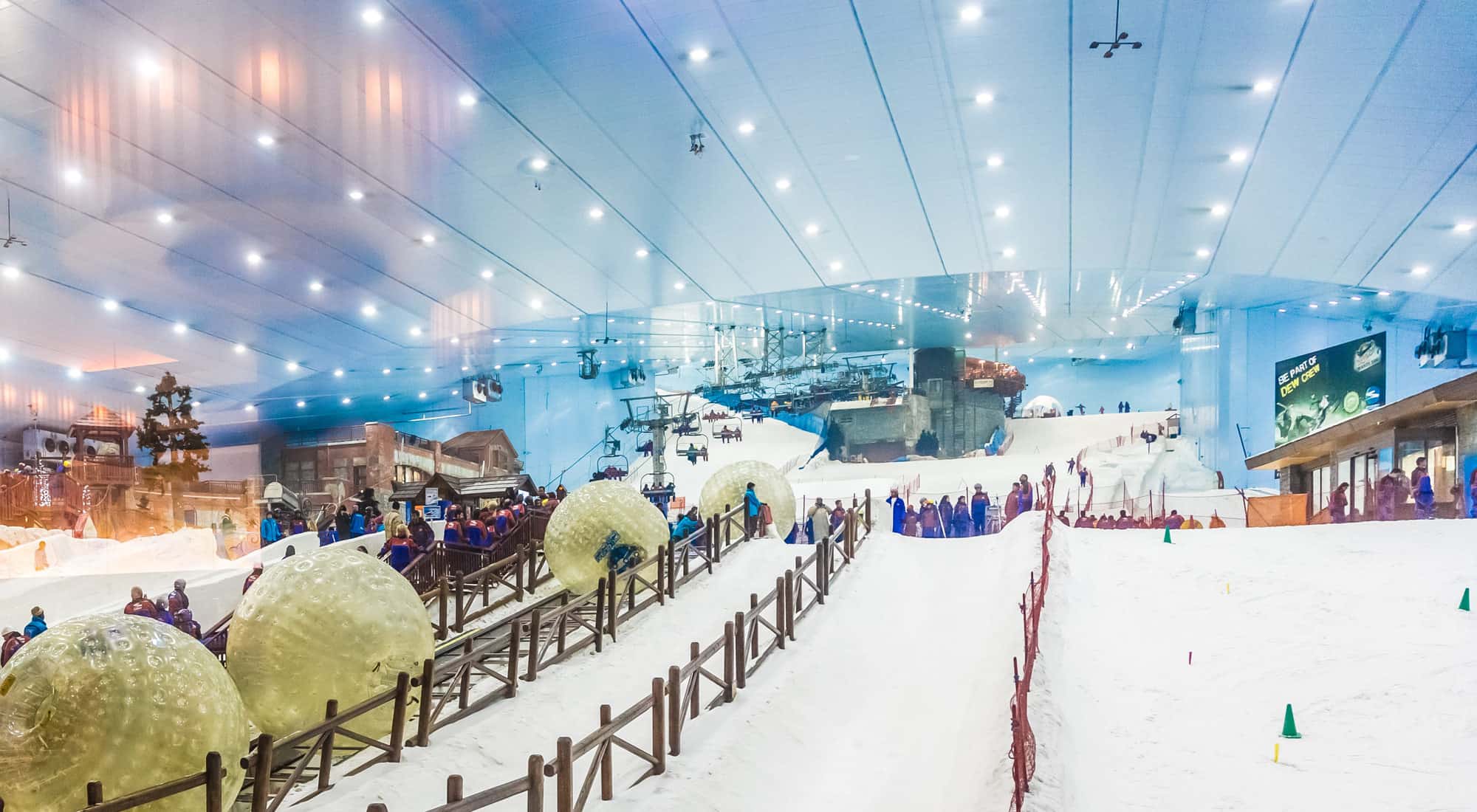
Dubai: una meta senza storia, senza cultura, senza niente che non sia stato costruito negli ultimi trent’anni con i soldi del petrolio e il lavoro semi-schiavile di operai del subcontinente indiano. Una città dove puoi sciare in un centro commerciale nel mezzo del deserto. Il tempio del pacchiano elevato a sistema urbanistico. E gli italiani, quelli che per decenni hanno rotto i coglioni dicendo “eh, l’America è pacchiana, è tutto esagerato,” dove trovano il loro paradiso? A Dubai. La città più pacchiana del pianeta Terra. L’incoerenza italiana elevata a biglietto aereo.
Dubai è diventata la patria dei fuffa-guru, degli scammer delle criptovalute, degli imbroglioni col Rolex falso e la Lamborghini a noleggio. E i viaggettisti italiani ci andavano in pellegrinaggio, come i loro nonni andavano a Lourdes, ma con meno dignità e più Instagram Stories.
Ecco: tutto questo sta finendo.
La guerra tra Stati Uniti, Israele e Iran, scoppiata il 28 febbraio 2026, sta facendo quello che il buon gusto non è mai riuscito a fare. Sta chiudendo i cieli. Sta bloccando gli aeroporti. Ha raddoppiato il prezzo del carburante. Ha messo a terra milioni di passeggeri.
I numeri sono biblici: oltre 70.000 voli cancellati, 14 milioni di passeggeri rimasti a terra, miliardi di euro di danni al settore aereo. British Airways ha sospeso i collegamenti con Abu Dhabi per gran parte del 2026. Cathay Pacific ha cancellato tutti i voli per Dubai fino a fine aprile. Volotea ha tagliato rotte in Italia, Francia e Spagna. Ryanair, la compagnia-totem del viaggettismo, quella che ha reso possibile l’intero fenomeno, ha lanciato l’allarme: se la guerra continua oltre aprile, tra il 10 e il 25 percento delle forniture di carburante potrebbe essere a rischio tra maggio e giugno. Michael O’Leary, l’uomo che ha venduto più biglietti a 9,99 euro di quanti panini siano mai stati mangiati sulle scalinate europee, ammette che la festa potrebbe essere finita.
Negli aeroporti italiani di Bologna, Linate, Treviso e Venezia sono scattate le prime limitazioni al carburante. La priorità va ai voli ambulanza, e ovviamente, ai voli di Stato. Per tutti gli altri, distribuzione contingentata. Due, duemilacinquecento litri per aeromobile. Finita la pacchia.
Il Financial Times parla della peggiore crisi del trasporto aereo dalla pandemia. E questa volta non c’è soluzione in vista. C’è uno Stretto di Hormuz bloccato e un presidente americano che dà le ennesime 48 ore di ultimatum con la delicatezza diplomatica di un ariete medievale.
E qual è l’aspetto positivo? Eccolo.
Il viaggettismo era un cancro. Era la riduzione del mondo a sfondo per selfie. Era la trasformazione di città millenarie in parchi a tema per turisti con lo zaino di Decathlon. Era Roma invasa da orde di stranieri in ciabatte che mangiano la pizza al taglio sui gradini di chiese del Cinquecento. Era Venezia ridotta a scenario per matrimoni di influencer. Era Barcellona, Lisbona, Amsterdam, Praga, tutte trasformate in succursali di un unico non-luogo globalizzato dove si beve la stessa birra, si dorme nello stesso Airbnb e si fotografa la stessa facciata senza sapere chi l’abbia costruita e perché.
L’ironia colossale è che gli stessi italiani che andavano a Dubai a fare i pagliacci sotto il Burj Khalifa potevano andare in località con storia, cultura, architettura. Non fondali partoriti dal marketing, invece, da venti anni a questa parte, scelgono puntualmente il pacchiano.
Ma per andare nei luoghi con storia, cultura, serve un turismo lento. Non di massa. Serve preparazione, curiosità, rispetto. Tutte cose che il viaggettista medio non ha. Il viaggettista medio ha solo una carta d’imbarco Ryanair e un Instagram pieno di filtri.
Adesso gli esperti del settore (quelli veri, non i travel blogger con i denti sbiancati che rassomigliano alla ceramica del cesso) consigliano mete europee o mediterranee. Voli diretti e brevi, entro l’Unione Europea. Niente scali nel Golfo. Niente pacchetti complessi. Spagna, Portogallo, Grecia, Canarie, isole greche, Sud Italia, Baleari. In altre parole: il Mediterraneo. Quello vero. Quello che è sempre stato lì, a portata di mano, e che il viaggettismo ha sistematicamente ignorato perché non era abbastanza esotico per il feed.
E forse, dico forse, qualcuno riscoprirà che non serve attraversare mezzo pianeta per trovare qualcosa di bello. Che il mare più bello d’Europa ce l’hai in Puglia, in Sardegna, in Sicilia. Che la storia più affascinante del Mediterraneo ce sotto casa, nei posti dove cammini e sotto i piedi hai migliaia anni di civiltà stratificata. Non i centri commerciali nel deserto con la neve artificiale.
Speriamo anche che la fine del viaggettismo colpisca in senso inverso. Che i viaggettisti stranieri che dall’estero infognano l’Italia, soprattutto Roma, dimuniscano. Che finisca anche per loro questa giostra malsana di trolley trascinati sui sampietrini, di Airbnb che hanno svuotato i centri storici, di code per un gelato da quattro euro che se va bene vale venti centesimi.
La guerra è una tragedia. Sempre. Non c’è nulla di buono in una guerra. Ma se un effetto collaterale di questa tragedia è la fine di un modello di turismo tossico, consumistico, vuoto, pacchiano e distruttivo, allora almeno una cosa buona la possiamo tirare fuori dal fango di questa immane tragedia.
Il viaggettismo è clinicamente morto. Lunga vita al viaggio vero. Quello lento, quello che ti cambia, quello che ti costringe a pensare, a capire, a rispettare. Quello che non si compra a pochi euro e non si racconta nelle stories.
Cronache di un’infamia digitale nella Gravina che ride quando sei vivo e finge di piangere quando sei morto
Pinuccio è morto. E i parassiti hanno fatto ciò che sanno fare meglio: trasformare anche la morte in contenuto.
Lo conoscevamo tutti, Pinuccio. Stava sempre in giro. In pineta. Dietro al Gallery. Nel centro storico. Tra i vicoli, i gradini, gli angoli dove Gravina si fa vedere per quella che è davvero: capace di salutarti, di nominarti, di riconoscerti, di darti cinquanta centesimi di euro, ma non abbastanza umana da proteggerti. Giuseppe Bellocchio, cinquantanove anni, disabile, povero, solo. Andava al distributore a comprare le sigarette per i clienti della città vecchia, tornava con il pacchetto e il resto preciso, e la mancia la lasciava al buon cuore. Non la pretendeva mai. Mostrava i tatuaggi di Jim Morrison e di Bob Marley sull’avambraccio a chiunque gli desse cinque minuti. Raccontava le scene dei film di Bud Spencer e Terence Hill, ma soprattutto, quelle di Bruce Lee, col sorriso di un bambino che ha deciso che quello, proprio quello, era il suo paradiso.
E mentre lui era lì fuori, vivo, vero, esposto al sole e al freddo e agli sguardi, c’era una pagina Facebook di merda che metteva la sua immagine al pubblico ludibrio.
Questa pagina esisteva davvero. Anzi, esiste ancora. Si chiama “Pam Pumè.” Pubblicava. Incollava la sua faccia ovunque. Lo appiccicava su Joker, su Trump, sul Papa, su 007, su qualsiasi cazzata la cultura pop sfornasse quella settimana. Non un episodio. Non una leggerezza. Non una sciocchezza isolata. Una pratica. Un metodo. Una piccola industria locale dell’umiliazione. Centinaia di meme. Centinaia di fotomontaggi. La faccia di un uomo che non poteva difendersi, usata come carta igienica digitale da una banda di sciacalli da tastiera, cialtroni col Wi‑Fi, pagliacci da fogna, falliti morali senza talento e senza vergogna, che, per sentirsi vivi, dovevano usare una persona vera come carburante delle loro squallide risate. Non era satira. Non era affetto. Non era folklore. Era bullismo digitale di branco travestito da goliardia paesana. Era un accanimento sistematico contro chi non aveva le risorse cognitive, economiche, sociali per restituire il colpo. Era la cosa più vile che una comunità potesse fare: ridere dell’ultimo degli ultimi e dichiarare che si trattasse solo di uno scherzo.
E la cosa che devasta di più è questa: Pinuccio, molto probabilmente, non sapeva nemmeno davvero cosa stessero facendo con la sua immagine. Non sapeva dell’archivio, della serialità, della scala di quella lurida catena di montaggio. E probabilmente neppure la sua famiglia lo sapeva. Perché la piazza vera, quella di pietra, quella dove Pinuccio camminava ogni giorno, almeno ti costringe a guardare in faccia l’uomo che stai umiliando e deridendo. Internet no. Internet ti permette di tirare pietre da dietro una tenda, di ridere in gruppo, di sentirti forte perché sei tanti contro uno che non sa nemmeno che esisti.
Poi arriva la morte. E questi vermi fanno il capolavoro.
31 marzo. La stessa pagina, la stessa cloaca, la stessa banda di parassiti coi pollici sporchi di like, pubblica il tributo commosso. Il salutino struggente. Il paradiso generato dall’intelligenza artificiale: Pinuccio tra le nuvole con Jim Morrison, Bob Marley e Bruce Lee. L’ultimo meme. L’ultima profanazione. L’ultimo fotomontaggio della serie, identico ai precedenti, con l’unica differenza che, stavolta, bisogna fingere di piangere invece di ridere. Cinquecento like. Novantasei condivisioni. La macchina funziona anche da morto. Forse funziona MEGLIO da morto.
“Ci mancherai amico nostro.”
No, bastardi. Non vi mancherà l’uomo. Vi mancherà il contenuto. Vi mancherà il pupazzo. Vi mancherà la faccia da riciclare per la prossima puttanata. Questo vi mancherà. L’uomo non l’avete visto mai. Avete visto solo la sua spendibilità.
E accanto a loro, a lucidare tutto, arrivano puntuali i tributi di chi Pinuccio, molto probabilmente, lo evitava, cambiando strada se lo vedeva. Hanno sprecato fiumi di inchiostro, digitale anche quello, con penne da sagrestia, per consegnare al pubblico una finta commozione. Questa pagina viene citata senza nessun contesto. Nessuna parola sui centinaia di meme che ha generato. Nessuna menzione degli anni di scherno. Zero. La pagina che per anni ha costruito la propria identità prendendo per il culo un uomo disabile viene citata come fonte di cordoglio ufficiale.
Il tributo postumo dei predatori viene riportato per intero, con reverenza, come se fosse un comunicato del Presidente della Repubblica. Pinuccio diventa “simbolo,” “leggenda gravinese,” monumento folkloristico — mai una volta “vittima. Le parole belle, a morte avvenuta, si trovano sempre. “Persona buona”, “fragile”, “animo buono”. Benissimo. Peccato che per troppo tempo, nel racconto pubblico, non sia stato trattato da persona ma da figurina, da maschera, da barzelletta pronta all’uso.
E le immagini AI vengono descritte come “immagini di addio create dai concittadini.” Create. Dai concittadini. Come fossero affreschi votivi e non l’ennesimo prodotto della stessa macchina che per anni ha macinato la dignità di un uomo per sfornare engagement. Parole di cordoglio come un servizio di lavanderia: si entra sporchi, si esce puliti.
E poi, ciliegina sulla torta, il GoFundMe. Cinquemila euro sfondati in poche ore per il funerale di un uomo che in vita non aveva i soldi per comprarsi le sigarette. Dove eravate quando era vivo? Eravate a pubblicare meme a ridere di lui. Eravate a condividere. Eravate a scrivere “AHAHAH” sotto l’ennesima immagine di Pinuccio, ora trasformato in Bruce Lee, ora in Papa, ora in agente segreto.
A questo punto lo dico, senza mezzi termini: stronzi, non avete il diritto di piangerlo. Non avete il diritto di intestarvi il cordoglio dopo aver amministrato la derisione. Non potete fare i becchini sentimentali dopo essere stati gli scemi del villaggio con Photoshop. Non potete dire “riposa in pace” dopo averlo preso per il culo per anni. Non potete generare paradisi artificiali per un uomo a cui avete costruito un inferno digitale.
Pinuccio non era un personaggio. Non era un simbolo. Non era una leggenda. Non era un format. Era una persona. E il modo in cui l’avete usato vi condanna più di qualsiasi insulto che io possa rivolgervi.
Seduto su un divano, ricevo una notifica di una notizia-flash. “Italia nuovamente fuori dai mondiali”. Sapete cosa ho fatto? Ho riso. Come un dannato, come un pazzo che balla sotto la pioggia, come un ubriaco che ruota attorno ad un palo mentre crede che sia il mondo a girare attorno a lui e non lui a delirare contro un palo.
Ve lo devo dire, con la brutalità che merita questa situazione, godo. Godo con la ferocia di chi ha guardato per vent’anni un sistema marcio, quello calcistico, fingersi vivo, un carrozzone di burocrati con vestiti di alta sartoria e gel nei capelli che vivono perennemente con le mani nella marmellata e che hanno spolpato il calcio italiano fino all’osso. E nonostante questo hanno avuto il coraggio criminale di fare la faccia sorpresa quando la carcassa si è definitivamente decomposta.
L’Italia è fuori dai mondiali da oltre quattromila giorni. Sarebbe un numero da mettere di fronte alla sede della FIGC e da far vedere ai ragazzini Italiani che non giocheranno mai in Serie A, e meno che meno in Nazionale. Perché al loro posto ci sono stranieri mediocri, con il passaporto giusto. Perché prendere gli stranieri…in fondo costa meno. E i club, con la lungimiranza di un tossico davanti all’ultima dose, hanno obbedito con entusiasmo a queste logiche.
Nel momento in cui ci sono soltanto tre italiani su dieci in campo nella massima serie del proprio Paese, è il momento in cui andrebbe chiuso tutto, mandati tutti a casa, iniziata una rivoluzione a ferro e fuoco. Immaginate di andare in un ristorante italiano in Italia e scoprire che 7 piatti su 10 sono stranieri. Probabilmente vi girerebbero un pochino le palle, e invece per il mondo calcistico italiano fatto di oscuri dirigenti, vecchi calciatori ormai infiacchiti, faccendieri e panzoni vari, tutto questo va bene. Perché tanto, alla fine, tutto si risolve con un paio di dimissioni, i soliti proclami, le solite chiacchiere. Non cambia mai nulla, e se qualcosa cambia, cambia in peggio.
Accendo un sigaro e invece di farmi un sangue cattivo, mi godo il momento e rifletto su come nessuno sia sorpreso, come al solito. Non è sorpreso Gattuso, che ha fatto quel che poteva con quei quattro scarsoni che aveva a disposizione. Non è sorpreso Gravina (vedete come certi nomi tornano sempre?) che ancora siede imperterrito su quella poltrona che forse, e dico forse, lascerà dopo la valanga di critiche che sta ricevendo.
Mentre tiro una boccata dal sigaro e scrivo queste chiacchiere dopo un bicchiere di Johnnie Walker Blue Label, credo che sia doveroso dirvi che la mia gioia non è puro sadismo né cinismo da quattro soldi. Non si tratta di Schadenfreude, cioè quella gioia meschina che prova chi gode delle disgrazie altrui. Si tratta di gioia POLITICA, anzi STRUTTURALE. La mia è la gioia di uno che vede crollare certi muri che, in realtà, erano da abbattere decenni fa.
Finché l’Italia sculava, come nell’ultimo Europeo vinto (immeritatamente), tutto andava bene e il sistema, ricolmo di incompetenti, sopravviveva. Nel frattempo, si andava avanti senza timore, a tutto vapore, col decreto crescita. Per chi non sa cosa sia questo benedetto Decreto Crescita, è un decreto che nel 2019 ha introdotto importanti facilitazioni fiscali per l’ingaggio di calciatori professionisti provenienti dall’estero.
I vivai per i ragazzi italiani? Chi se ne frega, costano e non rendono subito! La formazione calcistica? Ma quella è roba da tedeschi; noi abbiamo il talento naturale, noi abbiamo la tradizione. Cadiamo sempre su questa maledetta trappola della tradizione, del talento che sopperisce ad ogni forma di formazione, nel calcio, nella politica, nel ambito del lavoro, ovunque…
Bella parola la tradizione. Ma sai che cos’è diventata la tradizione italiana? Un vecchio vestito di tutto punto che balla un valzer in una sala vuota. Perfino la Norvegia ci ha asfaltati, quel paese che il pallone non sapeva nemmeno che cosa fosse. I norvegesi hanno fatto una cosa rivoluzionaria: hanno investito nei loro giovani, li hanno messi in campo, li hanno fatti giocare.
Noi no. Abbiamo comprato dall’estero, abbiamo importato, abbiamo riempito le rose dei club di giocatori che non potranno mai vestire l’azzurro. Poi ci meravigliamo se alla fine delle qualificazioni torniamo a casa sconfitti e con il culo che assomiglia a quello di un macaco.
Ma il bello deve ancora arrivare. Il bello è il DOPO. Calcagno dell’Assocalciatori esce col comunicato. Propone di destinare una quota dei diritti televisivi al minutaggio degli italiani. Bellissimo, Calcagno. Peccato che lo fai ADESSO, dopo che la casa è bruciata fino alle fondamenta. È come installare l’antifurto dopo che i ladri ti hanno portato via anche il bidet. E a chi la proponi?
Al ministro Abodi. Che risponderà con un comunicato, al quale risponderà un altro comunicato, al quale risponderà un tavolo tecnico, in un loop infinito che produce l’unica cosa che questa gente sa produrre: il NIENTE.
Me ne verso un altro bicchiere perché adesso dico la cosa che brucia più del whisky: il calcio italiano non è un caso isolato. Il calcio italiano È l’Italia. La miniatura fedele di un Paese che funziona esattamente così. Incompetenza senza pause, senza vergogna, senza conseguenze. Mai una conseguenza. MAI.
E guadagnano tutti. Il presidente della Federazione, i dirigenti delle Leghe, i procuratori…quelli poi GUADAGNANO OSCENAMENTE, avvoltoi che spostano carne da un club all’altro intascando percentuali che farebbero impallidire Sor Savino Capogreco. E se non sapete chi sia, non possiamo essere amici, siete sul blog sbagliato, andate a fare in culo anche voi che leggete.
Il Johnnie Walker è finito. Il sigaro pure. L’Italia calcistica era finita da un pezzo; la Repubblica Italiana è sulla buona strada.
Ovvero: come seppellire settecentotrentuno anni di storia sotto una colata di cemento burocratico, navette fantasma e porchetta di Ariccia… Diario allucinato dal ventre molle della Murgia.
La Fiera di San Giorgio l’ho vissuta. Ci sono cresciuto dentro. Ci andavo da bambino con la famiglia, da ragazzo con gli amici, da adulto per abitudine e per amore. Ci andavo perché era aprile e aprile a Gravina significava quello: la fiera. Come Natale significava il presepe e agosto significava il mare. Non era una scelta. Era un fatto biologico.
E già quando ero lì, già quando ci mettevo piede con le mie gambe, sentivo che qualcosa stava cedendo. Padiglioni sempre più tristi. Espositori sempre meno. Stand che l’anno prima erano pieni e l’anno dopo erano vuoti. La sensazione di camminare in un corpo che si stava svuotando dall’interno. Come un frutto che fuori sembra buono ma dentro è già marcio. Ricordo la gente che si accalcava alla fermata della navetta senza un addetto, senza una barriera, senza un segno qualsiasi di organizzazione. Ricordo una persona disabile abbandonata dal bus in mezzo a un parcheggio. Ricordo la faccia di mio padre che scuoteva la testa e diceva: non è più come prima. E non era più come prima. Non lo era già allora.
Ma il momento in cui ho capito che la fiera era clinicamente morta è stato quando ho visto la porchetta di Ariccia.
La porchetta di Ariccia. Alla Fiera di San Giorgio. A Gravina in Puglia. Nel cuore della Murgia. Nella campionaria regionale che per sette secoli ha rappresentato il commercio e l’agricoltura di questa terra. Porchetta laziale. Salsicce di Norcia. Arrosticini abruzzesi. Roba che con la Puglia non c’entra niente. Zero. Come mettere un kimono alla Statua della Libertà.
Gravina ha il Pallone e il Fallone, formaggi dal nome simile ma dalla natura diversa che rappresentano il territorio in una maniera pazzesca: la stagionatura e la freschezza e la maestria di chi li produce. Ha la focaccia. Ha il pane cotto nel forno a legna. Ha i latticini freschi, le carni fresche e stagionate. Ha l’agnello, le salsicce col finocchietto fresca e secca, la “pezzentella”, e tanto altro, forse, troppo. Ha la Verdeca DOC, che in teoria si chiama Gravina DOC, il vino bianco che porta il nome della nostra terra perché “Verdeca” fu “rubato” prima dai salentini. Ha le erbe selvatiche, il finocchietto, il cardo spinoso. Ha un patrimonio agroalimentare che metà delle regioni italiane se lo sognano. E alla fiera ti vendono la porchetta di Ariccia. È come se alla Oktoberfest servissero gli spritz, e addio birra. È un insulto al territorio, alla storia, ai contadini che per settecento anni hanno portato i loro prodotti sulla prateria di San Giorgio. È un insulto alla Verdeca. E tu, stronzo amministratore comunale o organizzatore esterno di una Fiera Storica, la Verdeca non la insulti.
Poi sono andato via. Ho attraversato l’oceano. Mi sono messo a ottomila chilometri di distanza. E la distanza, si sa, fa due cose: rende tutto più nitido e tutto più insopportabile allo stesso tempo. Come un bisturi che non puoi usare perché il paziente è su un altro continente.
Da qui, dalla Georgia, ogni aprile ricevo i bollettini di guerra. Messaggi, vocali, foto, sfoghi. E ogni anno è peggio. Ogni anno il racconto è più desolante di quello precedente. È una discesa nella follia. Una spirale che gira sempre nella stessa direzione: verso il fondo.
Mi dicono che i padiglioni sono vuoti. Non pochi espositori: vuoti. Aria e neon. Mi dicono che la gente entra, fa un giro di dieci minuti, e se ne va. Mi dicono che sembra una sagra di paese, un mercato rionale del giovedì, tutto tranne che una fiera con sette secoli di storia. Mi dicono che ogni anno peggio. E me lo dicono dal 2017. Otto anni consecutivi di caduta libera senza paracadute.
E per quest’anno, il 2026,la vedo peggio ancor prima che le fiera inizi.
Ma i fatti non sono solo racconti di amici. Sono documenti pubblici. E i documenti raccontano una storia ancora più allucinante di qualsiasi vocale WhatsApp.
Febbraio 1294. Carlo II d’Angiò firma un Regio Decreto. Esiste ancora, nei Registri Angioini. Concede a Gravina il privilegio di una fiera franca nella prateria di San Giorgio. Giovanni di Monfort, signore di Gravina, ne è il patrocinatore. Confermata nel 1436 da Alfonso I d’Aragona a Francesco Orsini. Ribadita dalla Camera della Summaria nel 1634. Sancita da Ferdinando II di Borbone nel 1854. Sette secoli di continuità documentata. Sopravvissuta a tutto: Angioini, Aragonesi, Borboni, terremoti, peste, brigantaggio, due guerre mondiali, fascismo, Repubblica. A tutto tranne che alle amministrazioni comunali di Gravina in Puglia.
Nel 2017, interrogazioni formali sulle procedure di gara. Rinvii. Risposte che non convincono. Nel 2018, bilancio in rosso, pubblicato solo su richiesta dei consiglieri. L’assessore delegato si dichiara non coinvolto. Nel 2019, chi governa ammette che le ultime due edizioni non erano all’altezza. Il pubblico fischia alla cerimonia di chiusura. Un consigliere regionale scrive un pezzo il cui titolo dice tutto: sette anni per distruggere sette secoli di tradizioni. Pubblico, protocollato, mai smentito nella sostanza. Nessuno risponde. A Gravina non si risponde mai. MAI. Non importa chi sia al timone (o al trimone).
Nel 2020 arriva il Covid. La fiera si ferma. E non torna né nel 2021 né nel 2022. Tre anni di buio. Una fiera che aveva resistito alla peste nera e al terremoto del 1456 si ferma perché nessuno invia un modulo alla Regione. Perché è questo il fatto: quando arriva la nuova amministrazione, la fiera non risulta nemmeno nel calendario regionale. La domanda annuale di inserimento non era stata inviata. La spiegazione ufficiale parla di equivoci e di mancati solleciti. La situazione viene risolta. Ma il fatto resta.
Nel 2023 la fiera torna. L’intento dichiarato: riportarla ai fasti di un tempo. Frase bellissima. La pronuncia ogni amministrazione da vent’anni. Come un mantra che non funziona, ma lo ripeti perché non sai fare altro.
E arriviamo al 2025. La 731ª edizione. A febbraio viene avviata una procedura negoziata per l’organizzazione. Budget: circa 250.000 euro. Entro la scadenza arriva una sola offerta. Una. Per la fiera più antica d’Italia. In una regione dove i consorzi spuntano come funghi. Una sola offerta. Questo numero è la radiografia di un corpo morto.
Il PD denuncia padiglioni vuoti e l’assenza di pianificazione. Forza Italia, dello stesso schieramento della maggioranza, pubblica un comunicato di disappunto. Quando la tua stessa parte politica ti sconfessa sulla fiera, non è un segnale. È il necrologio. Il primo cittadino risulta assente nei momenti chiave, presente solo alla consegna simbolica delle chiavi, in occasione della chiusura. Il gesto perfetto: arrivi quando è finito tutto, sorridi, parli di successo e poi te ne vai.
E la fiera non ha mai avuto un ente fiera. Mai. In 731 anni. Nessuna struttura permanente. Ogni anno si ricomincia da zero. Ogni anno si improvvisa. A febbraio 2025, la giunta delibera l’avvio di uno studio di fattibilità per la costituzione di un ente giuridico. Uno studio di fattibilità. Nel 2025. Per una fiera del 1294. Il PD chiede se lo studio sia proseguito. Risposta non pervenuta.
E tutto questo accade mentre Gravina si candida a Capitale Italiana della Cultura 2028. Si candida, va a Roma, si siede davanti alla commissione ministeriale nella Sala Spadolini, e perde. Male. Perché in audizione succede esattamente quello che succede alla fiera: arrivano con la retorica e senza i contenuti.
La commissaria Piacentini chiede al delegato alla cultura una cosa semplice, concreta, l’unica domanda che conta: quali risultati economici e occupazionali vi aspettate da questo progetto? Risposta testuale, registrata, pubblica: “Per quanto riguarda le ricadute economiche, pensiamo che queste possano essere una reale conseguenza di quello che andiamo a fare, però al momento non siamo attenti a questo.” Non siamo attenti a questo. In una candidatura che vale un milione di euro dal Ministero e un piano pluriennale dichiarato di quaranta milioni. Non siete attenti alle ricadute economiche. Ma allora a cosa siete attenti? Ai mandorli?
Il professor Baia Curioni fa una domanda chirurgica: qual è il rapporto tra Gravina e Matera? Perché Gravina dopo Matera? Convinceteci che questa sequenza è ottimale per l’Italia. La risposta parla di “paradigma della quadrupla elica”, di “humus fertile”, di “contraddizioni comuni.” Nessun dato. Nessun progetto concreto. Nessuna cifra. Il paradigma della quadrupla elica. Davanti a una commissione tecnica del Ministero della Cultura. È come rispondere a un esame di ingegneria con una poesia.
E intanto l’ex sindaco di Matera, seduto lì a fare il testimonial, recita il suo monologo: “La Murgia è radioattiva.” “Ho accompagnato Vittorio Storaro tra le balze rocciose.” “Solo qui ho avuto tumulti di creatività.” “È un luogo omerico nei suoi colori e biblico nella sua forza.” “Questo è quello che ci rende potenti e indomabili.” Retorica pura. Zero dati. Zero progetti. Zero cifre. Parla come se fosse al Festival della Letteratura, non davanti a una commissione che deve decidere dove mettere un milione di euro. E nessuno, in tutta la delegazione, ha il coraggio di interromperlo e dire: grazie gentilissimo, bellissimo, ma adesso parliamo di cultura, programmazione, logistica ed infrastrutture.
Perché le infrastrutture non ci sono. Il teatro principale è chiuso da trent’anni. Il cinema più grande della provincia, il Centrone, duemila posti, stile liberty, è abbandonato e visitato dagli urbexer come fosse Chernobyl. L’ultimo cinema rimasto, il Sidion, ha chiuso nel 2023. Gravina nel 2026 ha un solo teatro privato, il Vida. Nessun cinema. Zero infrastrutture culturali pubbliche. E con questa dotazione si candidano a Capitale della Cultura d’Italia.
Ma il momento più rivelatore dell’intera audizione è quando una studentessa legge un discorso che qualcuno le ha scritto con il tono di un manifesto d’altri tempi: “Vogliamo essere la primavera sacra che porta nel mondo la legge, la scienza, le arti e i mestieri.” “Saremo la nuova Magna Grecia perché vogliamo vivere da eroi.” “Noi vogliamo essere indimenticabili.” “Vogliamo che le epoche che verranno guardando a noi dovranno chiedersi come abbiamo fatto.” Come avete fatto cosa, esattamente? Come avete fatto a chiudere due teatri, perdere 187 residenti all’anno e organizzare la fiera più antica d’Italia con la porchetta di Ariccia nei padiglioni?
Poi arriva il turno degli imprenditori locali e spiegano che a Gravina c’è un “movimento di pensiero” chiamato Murgia Valley, nato da imprenditori che fanno le camminate la domenica. Camminate la domenica. Contro l’emorragia demografica del Mezzogiorno. Contro la fuga dei cervelli. Contro lo spopolamento. Camminate. La domenica.
Gravina perde. Vince Ancona. E la cosa più tragica non è la sconfitta. La cosa più tragica è che a Gravina nessuno sembra aver capito perché hanno perso. Continuano a parlare di radici al futuro e di memoria attiva. Continuano a organizzare la fiera con una sola offerta pervenuta e con i padiglioni vuoti. Continuano a mandare il primo cittadino solo per la consegna delle chiavi. E continuano a vendere la porchetta di Ariccia al posto del Pallone di Gravina.
Io sto qui, dall’altra parte dell’oceano, e ogni aprile apro il telefono sapendo già cosa troverò. L’ennesimo vocale dell’ennesimo amico che mi dice la stessa cosa con parole diverse. La stessa rabbia. La stessa vergogna. La stessa frase finale che ormai è diventata un ritornello funebre: ogni anno peggio.
Nella sua versione più bella, la fiera era una distesa immensa gremita di bestiame, uno schioppettìo di fruste, un intreccio di dialetti, bicchieri di Verdeca e catene d’argento al sole di aprile. Le mura non bastavano. Si alzavano baracche fuori dalle porte. Gravina si apriva al mondo, e il mondo veniva a Gravina.
Potrebbe ancora venire. Con il Pallone, il Pane di Altamura, la Burrata di Andria, la Verdeca DOC, le carni della Murgia, le erbe selvatiche, il Parco dell’Alta Murgia i progetti seri e concreti, non le chiacchiere. Con un ente fiera vero e una programmazione culturale, economica, di sviluppo che dura dodici mesi e ad aprile culmina. Ma per questo serve l’unica cosa che manca ormai da troppo temlo: la volontà di trattare la storica fiera di Gravina come un patrimonio e non come una voce di bilancio da riempire con la porchetta di qualcun altro.
A dispatch on fragments, frustration, and the long work of piecing together a past that nobody seems eager to preserve.
There is a particular kind of exhaustion that comes from trying to report on something that exists mostly in absences. Not the clean, dramatic absence of a ruin, a toppled column or a roofless temple, but the bureaucratic, logistical, cultural absence that surrounds southern Italy’s archaeological record like fog around a hillside. I have been trying, for the better part of two years, to assemble a long form project about the archaeological landscape of the Italian Mezzogiorno, and I can tell you with some authority that the story does not want to be told. Not because it isn’t there, but because it has been scattered, buried, stolen, ignored, and, perhaps worst of all, filed away in archives that no one will let you see.
Let me be specific about what I mean. I am working on several interconnected pieces, all of which orbit the same gravitational center: the deep past of southern Italy and the astonishing indifference with which it has been treated. One thread follows Gravina in Puglia, the town where my family is from, a place that sits on the western lip of the Murge plateau, perched above a ravine so deep and ancient that the town takes its name from it. Another thread traces the broader archaeology of the Fossa Bradanica, that vast tectonic depression running between the Apennine chain and the Murge highlands, a landscape that has been continuously inhabited since the Paleolithic but remains, even in Italy’s own scholarly record, remarkably under documented. A third thread moves west into Campania, to the ancient Greek colonial sites along the coast, where the question is not what remains to be discovered but what has already been lost, dispersed across the collections of Europe and America before anyone thought to ask whether it should stay.
Each of these threads, individually, should be straightforward to report. Together, they amount to a kind of journalistic obstacle course that I suspect would be familiar to anyone who has tried to do serious cultural reporting in the south of Italy.
The Problem of Sources
Start with the most basic challenge: navigating the system. Southern Italian archaeology is a world of overlapping jurisdictions, underfunded regional heritage authorities, and local officials who oscillate between defensive pride and total disinterest depending on whether they think you are writing a tourism piece or an exposé. Italy’s heritage protection system, the network of regional superintendencies that oversee archaeological sites, is at once the country’s greatest asset and its most maddening bottleneck. Everything flows through it. Permission to visit a site, to photograph a dig, to access an archive, to reproduce an image of a pot shard: all of it requires paperwork that moves at a pace calibrated to geological time.
Then there is a paradox that anyone working on southern Italian archaeology will eventually confront. Much of what we know about these sites, we owe to foreign scholars. British and anglophone archaeologists conducted the foundational fieldwork at places like Botromagno, the ancient hill settlement outside Gravina. Without their surveys, their publications, their decades of patient excavation, much of this material would still be invisible to the wider world. The irony is bitter. Italy’s own scholarly infrastructure has often failed to document, synthesize, or make accessible the archaeology of its own south. The Italian language literature that does exist tends to be scattered across specialized journals with small print runs, limited digital presence, and no systematic indexing. Conference proceedings gather dust. Gray literature disappears into ministry filing cabinets. The comprehensive Italian language narrative of these places, the one you would expect the host country to have produced, largely does not exist.
For Gravina specifically, the problem compounds. The town sits on one of the most archaeologically layered sites in Puglia. Botromagno was a major settlement of the indigenous Italic people who inhabited the region before Roman contact, a place ancient geographers described as among the most important cities of its tribal territory. We know this in large part because anglophone researchers made it their business to find out. The archaeological park there covers hundreds of hectares. There are Neolithic remains, Iron Age traces, painted tombs from the fifth century BCE, the ruins of a Roman villa, a medieval castle, rock cut churches from the Byzantine period, an underground network of tunnels and cisterns that runs beneath the modern town like a second city. A necropolis. Interconnected chambers carved into the cliff face across multiple levels. And just a short distance away, one of the oldest and most intact early human skeletal finds in Europe, sealed in a cave and encased in mineral deposits for well over a hundred thousand years.
All of this exists. Very little of it has been pulled together by Italian scholarship into the kind of comprehensive, readable narrative that a place this extraordinary deserves. The local archaeological museum houses artifacts spanning millennia, but the published catalog is incomplete. Local historians have produced passionate but uneven accounts. The foreign fieldwork is rigorous but narrow in scope. Nobody on the Italian side has stitched it together. The reason is that the source material is fragmented across institutions, languages, and decades in a way that makes synthesis an act of sheer stubbornness, and the institutional will to do it has simply not been there.
The Fossa Bradanica: A Landscape Without a Story
Move outward from Gravina and the problem only deepens. The Fossa Bradanica is one of the most geologically and archaeologically significant landscapes in the Mediterranean. It is the deep trench that separates the Murge limestone plateau from the Apennine mountains, a depression filled with ancient sediments, carved by rivers that have been reshaping it for millions of years. The ravines that score its edges, the gravine from which towns like Gravina and its neighbors take their names, are among the most dramatic karst formations in Europe. The region preserves evidence of human habitation stretching back to the Lower Paleolithic.
Here again, it has been foreign researchers who have done much of the heavy lifting. Major English language field surveys of the Bradanic trough and the Basentello Valley represent some of the most thorough work ever conducted in this area. Italian geologists have studied the tectonic structure extensively, but when it comes to the archaeology, the Neolithic settlements, the Eneolithic sites, the Bronze Age transitions, the dense network of indigenous villages that dotted the Murge during the Iron Age, the Italian language documentation is thin, scattered across conference proceedings and gray literature, and difficult to access even for those who know where to look.
The Murge plateau itself, now partly protected as a national park, is a landscape of extraordinary richness. It preserves sub steppe grasslands, karst formations, and the traces of an agro pastoral civilization that shaped the terrain for millennia: the dry stone enclosures, the sheep rearing structures, the network of ancient drove roads. But the interpretive infrastructure is minimal. Signage is sparse. Guided access is limited. There have been efforts to secure international geopark recognition, which could change things, but the process is slow, and in the meantime, the sites sit in a kind of administrative limbo, known to specialists but invisible to the broader public.
Campania: What Was Lost
If the Puglia material presents the challenge of assembling a story from fragments, the Campania material presents something worse: the challenge of accounting for what is gone.
The great Greek colonial sites along the Campanian coast are, on paper, success stories. They hold international heritage designations. The three great Doric temples at one site are among the best preserved Greek temples anywhere in the world. A famous painted tomb discovered there in the late 1960s is singular: the only known example of Greek figural painting from the Archaic or Classical period to survive intact. At the other major site, the ancient city founded by refugees fleeing the Persian conquest of Ionia, the walls and acropolis survive, along with a monumental arched gate that is unique in Greek architecture on Italian soil, and the memory of a philosophical school that shaped Western thought.
But the story of these sites is also, inescapably, a story of hemorrhage. The local museum holds the largest collection of material from the area, but a significant number of artifacts were removed before modern protections existed and are now distributed across collections worldwide. Major museums in Spain, France, Germany, and the United States hold important pieces: Roman statuary, fine painted pottery attributed to identified workshop hands, architectural fragments. A temple complex at a nearby river mouth is now nearly destroyed. Some of the archaic relief panels were recovered, but how many weren’t?
The problem is not unique to these sites. It is systemic. Investigators have estimated that tens of thousands of tombs have been looted across southern Italy, representing hundreds of millions of dollars in stolen heritage. For decades, criminal networks funneled artifacts from the hands of tomb robbers, who worked under cover of darkness with shovels and metal detectors, through intermediaries abroad, where the objects were cleaned up, given false provenance papers, and sold at auction to dealers and institutions around the world. Italy’s art crimes police have spent decades tracking these networks, and their work has been heroic. But what they recover is always a fraction of what was taken. Painted frescoes ripped from the walls of an ancient tomb and recovered twenty years later are a miracle of investigative persistence. They are also a reminder that we will never know which tomb they came from, what else it contained, or what story its full contents might have told.
At the site founded by the Ionian refugees, the losses are quieter but no less real. It has suffered less from organized looting than from slow neglect, the attrition of exposure, underfunding, and the sheer difficulty of maintaining a sprawling archaeological zone in a region where resources are perpetually scarce. Recent restoration work has been encouraging, but the site remains far less visited and less studied than its more famous neighbor, and its potential as a window into the colonial Greek world and the intellectual tradition it produced remains largely unrealized.
The Work Ahead
I write all of this not as complaint but as context. When you set out to tell the story of southern Italian archaeology, you are not simply reporting on ruins. You are navigating a landscape where the physical past and the institutional present are tangled together in ways that resist easy narration. The sources are scattered. The Italian archives are difficult. The foreign scholarship is essential but incomplete. The funding is inadequate. The looting, historical and ongoing, has created gaps in the record that can never be fully closed. And perhaps most frustrating of all, the country that should be most invested in telling these stories has too often left the work to outsiders.
And yet, the story is there. It is there in the ravine at Gravina, where rock cut churches from the early Middle Ages share cliff walls with caves that sheltered humans in the Neolithic. It is there in the Fossa Bradanica, where the first farmers built permanent settlements on soil deposited by ancient seas. It is there on the Campanian coast, where a young man painted on the underside of a tomb slab dives forever into an unknown sea, the only image of its kind to survive from the Greek world.
These are stories that belong to the places where they happened. Getting them right, getting the sources, the access, the context, the nuance, is slow, frustrating, sometimes infuriating work. But it is work worth doing, because the alternative is silence. And silence, in archaeology, is just another word for loss.
The author is currently developing a multi part project on the archaeology of southern Italy, with particular focus on Gravina in Puglia and the Murge/Fossa Bradanica region, and on the dispersal of archaeological heritage from the ancient Greek sites of Campania.

 Vincenzo martemucci
You must be logged in to post a comment.